If you own or are shopping for a BMW iX, you’ve probably heard about battery state of health (SOH). For a luxury EV with a six‑figure MSRP when new, understanding BMW iX state of health isn’t just a technical curiosity, it’s central to long‑term value, range, and peace of mind, especially on the used market.
Why SOH matters on a BMW iX
BMW iX state of health (SOH): the basics
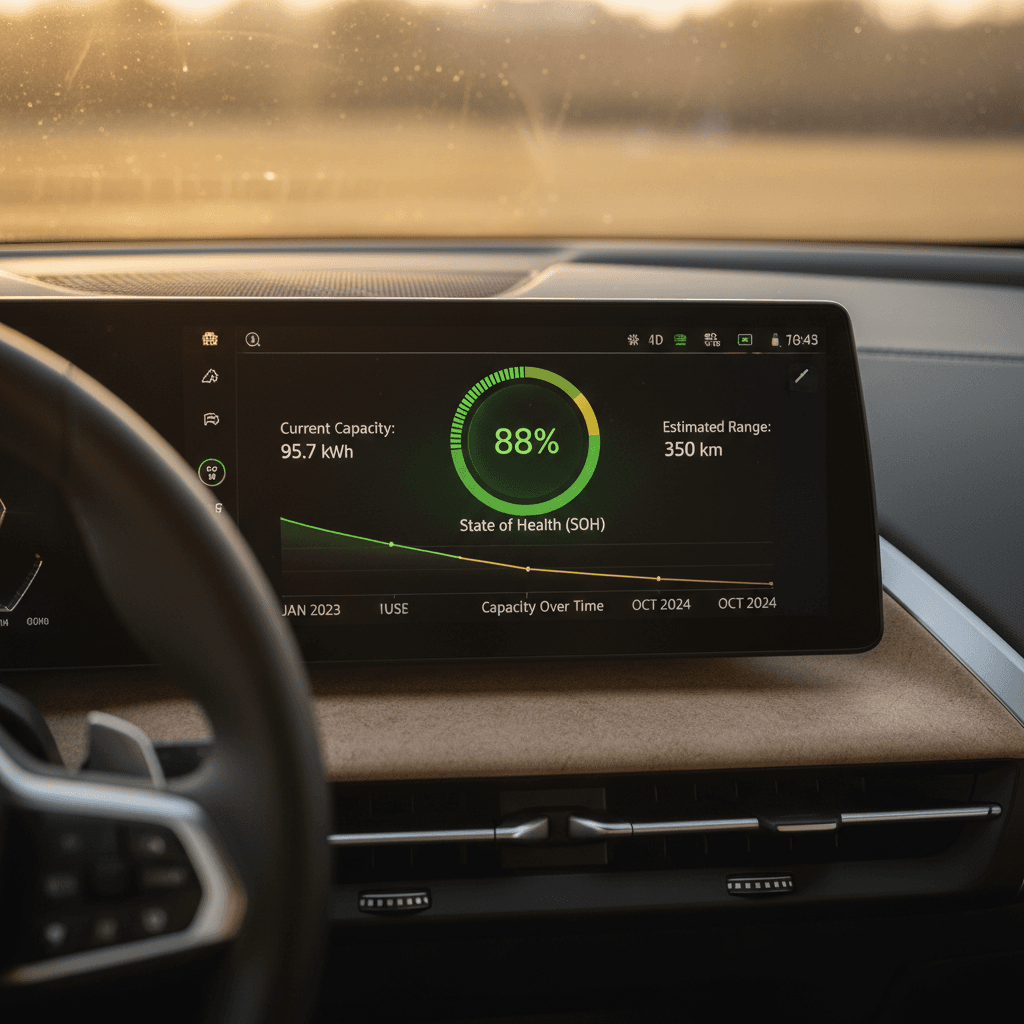
In simple terms, state of health (SOH) is the battery’s condition compared with when it was new. On a BMW iX, SOH is usually expressed as a percentage of the original usable capacity, so 95% SOH means the pack can still store about 95% of the energy it could when it left the factory.
- New iX packs start near 100% SOH and slowly decline over time.
- SOH is mainly about capacity (how many kWh the pack can hold), not day‑to‑day state of charge (SOC).
- Degradation is usually fastest in the first couple of years, then slows and plateaus.
- Normal use and smart charging habits typically keep SOH well above BMW’s warranty threshold for many years.
Most BMW iX owners will never see SOH displayed as clearly as phone battery health. Instead, BMW tracks pack condition in its internal systems and via data logs. That’s why understanding where to find those numbers, and how to interpret them, is so important if you plan to keep your iX long‑term or are considering a used one.
BMW iX battery fundamentals
How BMW actually measures iX battery health
BMW doesn’t give iX drivers a one‑tap SOH readout in the My BMW app. Instead, the vehicle’s battery management system constantly monitors voltage, temperature, charge/discharge history, and pack impedance to estimate remaining usable energy and overall health. That information is exposed in a few different ways:
Where SOH lives inside the BMW ecosystem
Behind the simple range estimate, there’s a lot of quiet math happening.
BMS (Battery Management System)
The iX’s BMS tracks cell voltages, temperatures, and charge history. From that, it estimates usable kWh and flags any modules that are out of line.
This is the source of truth BMW uses for warranty decisions.
Dealer diagnostic tools
BMW dealers can run a high‑voltage battery test. This can take several hours and requires the car to be at a specific SOC window.
You may see results described as “battery OK” vs. “below spec,” rather than a simple percentage.
BMW CarData report
Through BMW’s online portal, some owners can request a CarData report showing items like “maximum energy content” and “energy content of the high‑voltage battery.”
Interpreted correctly, those fields give you a real‑world view of SOH.
SOH is not the dash range number
Ways to check BMW iX state of health
Even though BMW doesn’t surface a clean “SOH: 94%” line item in the My BMW app, you still have several ways to understand your BMW iX state of health. Each has pros and cons in terms of accuracy, effort, and how friendly it is for a buyer or seller.
Four practical ways to assess BMW iX battery SOH
1. Request BMW CarData
In many markets, you can log into BMW’s online portal (e.g., My Garage in the U.S.) and request a <strong>CarData</strong> export. The report may include values like “maximum energy content of the high‑voltage battery” and “energy content of the high‑voltage battery.” Comparing those to the pack’s original usable capacity gives you a rough SOH estimate.
2. Ask the dealer for a battery test
If you suspect a problem or are evaluating a high‑mileage iX, you can ask a BMW dealer to run a <strong>high‑voltage battery check</strong>. It can take several hours and may carry a fee if the battery is above warranty thresholds, but it’s the closest thing to an official verdict.
3. Use OBD‑based third‑party tools
Enthusiast‑oriented apps (accessed via an OBD dongle) can read live data from the BMS, including pack energy content and sometimes an explicit <strong>SOH percentage</strong>. This is more technical, but it’s the best view you’ll get outside BMW’s own systems.
4. Do a controlled range or kWh test
For a hands‑on check, charge to 100%, then drive a long mixed cycle and either log <strong>energy drawn from the charger</strong> or <strong>miles driven vs. efficiency</strong>. It won’t be perfect, but if you know what the pack offered when new, you can infer approximate SOH from real‑world capacity.
Use multiple signals, not just one
What is “normal” BMW iX battery degradation?
Real‑world reports from iX owners suggest that early capacity loss in the first year or two is followed by a longer, flatter period of very slow degradation. That’s consistent with what we’ve seen across modern lithium‑ion EVs in general.
Typical BMW iX SOH over time (real‑world, not a promise)
- Year 1–2: It’s common to see the equivalent of about 3–7% loss as the pack settles.
- Years 3–5: Degradation usually slows. Many owners report SOH still in the low‑ to mid‑90s with tens of thousands of miles.
- Years 6–8: Well‑treated packs often remain comfortably above BMW’s roughly 70% warranty floor.
Exact numbers vary by climate, charging habits, and how hard the car is driven, but the iX’s large pack gives it a lot of cushion.
Outliers and red flags
- A dealer test suggests the pack is near or below BMW’s warranty threshold (roughly 70% SOH equivalent).
- Range at 100% has dropped dramatically vs. new (20–30% less) despite similar conditions and driving.
- The car throttles DC fast‑charging far more than expected, even in warm weather and at low SOC.
- The car throws high‑voltage battery warnings or repeatedly limits power.
Any of these are reasons to dig deeper, especially on a used iX outside its basic new‑car warranty.
Degradation is not linear
BMW iX battery warranty and SOH thresholds
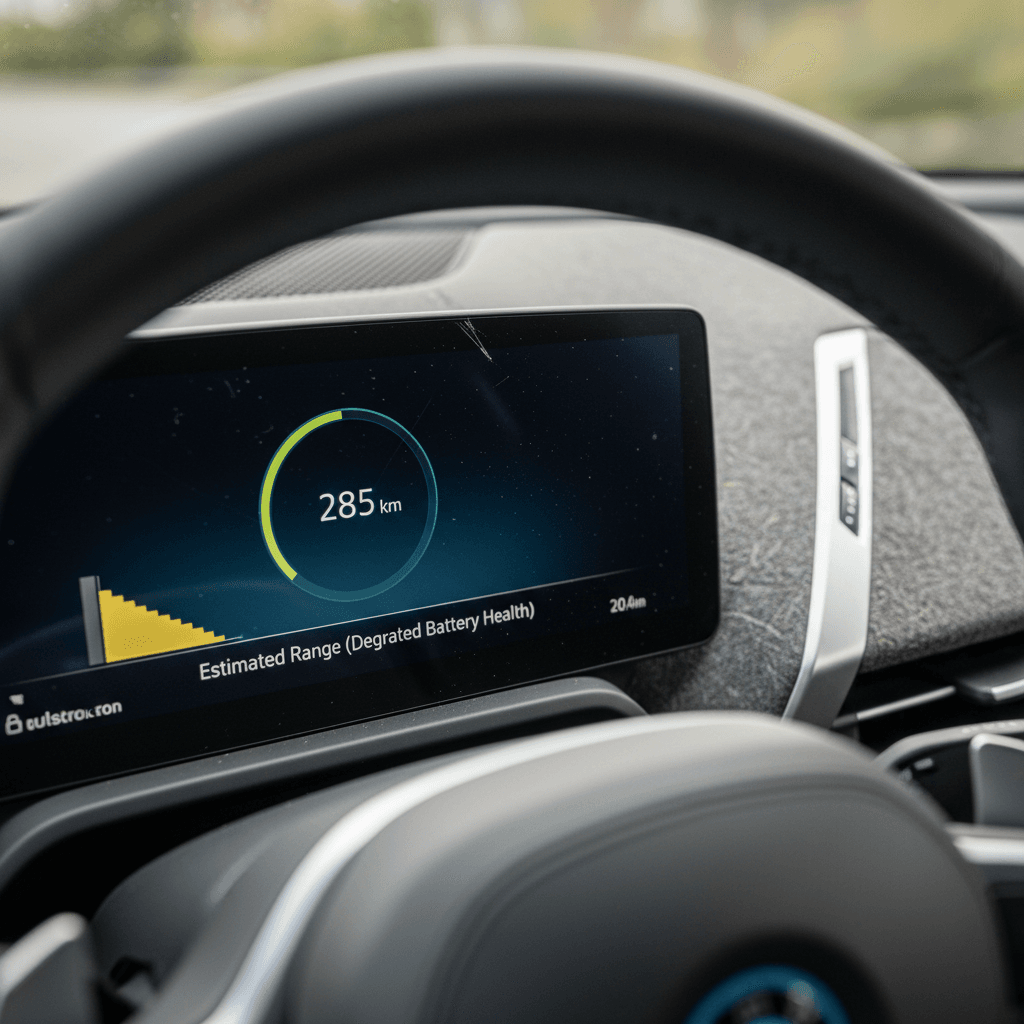
In the United States, the BMW iX high‑voltage battery is covered by an 8‑year / 100,000‑mile warranty (from original in‑service date). BMW, like other automakers, doesn’t usually publish a simple SOH percentage in consumer documents, but in practice the warranty is aimed at protecting you from excessive degradation, not from every small loss of range.
BMW iX battery coverage at a glance
Always confirm details with BMW or your local dealer for your specific VIN and market.
| Item | Typical Coverage | What It Means For You |
|---|---|---|
| High‑voltage battery warranty | 8 years / 100,000 miles | Covers manufacturing defects and abnormal capacity loss, from the original in‑service date. |
| Degradation threshold | ~30% loss allowed | If usable capacity falls more than roughly 30% below spec (≈70% SOH), BMW may repair or replace under warranty. |
| Dealer test access | Yes, by request | Dealers can run an official high‑voltage battery test; fees may apply if capacity is above warranty limit. |
| Transferable to new owner? | Yes, usually | If you buy a used BMW iX, remaining battery warranty time/miles typically transfer with the car. |
These are general U.S.‑market guidelines for BMW EV high‑voltage battery coverage.
Don’t assume the pack is covered forever
Driving and charging habits that protect SOH
The good news is that you have a lot of control over your BMW iX state of health. The chemistry in the big pack under the floor is well‑understood; the things that shorten its life are familiar, and you can avoid most of them with a few simple habits.
Habits that keep your iX battery healthy
Think of them as long‑term maintenance for your range and resale value.
Favor AC charging at home
Use Level 2 AC charging for day‑to‑day use. It’s easier on the cells than frequent DC fast charging.
Save DC fast charging for road trips or true need, not every commute.
Avoid sitting at 0% or 100%
It’s fine to charge to 100% before a trip, but don’t leave the iX sitting full (or nearly empty) for days.
For routine use, many owners set targets around 70–80%.
Watch temperature extremes
High heat plus high SOC is hard on any EV pack. If possible, park in shade or a garage during hot summers.
In deep cold, expect temporary range loss, not permanent SOH damage, as the pack warms up in use.
Drive smoothly
Repeated full‑throttle launches and high‑speed runs won’t instantly kill the pack, but they add stress over time.
Smoother driving often means more range, fewer charge cycles, and gentler degradation.
Update software and follow recalls
BMW sometimes refines thermal management, charging behavior, and BMS algorithms through software updates.
Staying current can help the car take better care of its own battery.
Store smart if you won’t drive it
If your iX will sit for weeks, aim to leave it around 40–60% SOC in a cool environment.
That storage window is where lithium‑ion cells are most comfortable long term.
Normal use is not abuse
Used BMW iX battery health checklist
If you’re considering a used BMW iX, battery SOH is one of the biggest invisible variables in the deal. Two outwardly identical SUVs can have very different long‑term value depending on how their packs were treated. Here’s a practical way to screen a candidate before you sign anything.
Pre‑purchase BMW iX battery health checklist
1. Confirm in‑service date and mileage
Ask for documentation showing when the iX was first put into service and its current odometer reading. This tells you how much <strong>warranty runway</strong> is left on the high‑voltage battery.
2. Ask for a BMW battery test or CarData report
A seller who can share a recent <strong>dealer battery test</strong> or BMW CarData export is giving you valuable transparency. Look for notes about energy content or explicit capacity percentages, and ask questions if anything seems off.
3. Compare real‑world range to original specs
Look up the original EPA range for that iX variant, then take a similar‑condition test drive (weather, speed, and route). If the car’s projected or demonstrated range is down by 20–30% with no obvious explanation, that’s a negotiation or walk‑away signal.
4. Review charging history and usage patterns
If possible, ask how the car was charged, mostly home Level 2, or daily DC fast charging? Was it parked outside in very hot climates? High fast‑charge use and constant high‑SOC storage can accelerate degradation.
5. Look for error messages or power limits
Scan the dash and ask about any history of high‑voltage battery warnings, sudden range drops, or frequent power‑limit messages. These can point to underlying battery or BMS issues.
6. Get an independent EV‑savvy inspection
If you’re not comfortable interpreting SOH data yourself, consider an inspection by an EV‑experienced shop or a service like <a href="/articles/recharged-score-explained">Recharged’s battery‑focused evaluation</a> before you buy.
Beware of “range only” storytelling
How Recharged evaluates BMW iX battery health
Because the BMW iX is a sophisticated and expensive EV, we treat its battery as the heart of the transaction. At Recharged, every iX we sell or appraise comes with a Recharged Score Report that pulls battery health out of the shadows and puts it in plain English.
What we look at on a BMW iX
- Diagnostic data: We pull high‑voltage battery information from the car’s systems and cross‑check against BMW specs for that model year and pack size.
- Charging patterns: Where history allows, we look at how the vehicle has been charged and used over time.
- Range behavior: We test in real‑world conditions to see if range and efficiency line up with what the data predicts.
- Error history: Our specialists check for current or stored faults related to the high‑voltage system.
How that becomes a Recharged Score
- Battery health rating: A clear, buyer‑friendly summary of SOH and how it compares to similar iX models of the same age and mileage.
- Fair value pricing: Our marketplace pricing reflects the battery’s condition, not just the odometer and options list.
- Guided support: EV‑specialist advisors walk you through the report, so you understand what the battery data means in day‑to‑day driving.
- Trade‑in clarity: If you’re selling or trading an iX, that same transparency helps you understand your car’s true market position.
BMW iX battery SOH: FAQ
Frequently asked questions about BMW iX state of health
Key takeaways on BMW iX state of health
The BMW iX was engineered around a large, sophisticated battery pack, and most examples on the road today are showing comfortably healthy state of health. Still, SOH is too important to leave to guesswork, especially if you’re buying or selling used.
- SOH is about capacity, not just the range number on the dash.
- BMW doesn’t surface SOH plainly in the app, but dealer tests, CarData reports, and OBD tools can reveal usable energy and pack condition.
- Moderate early degradation is normal; what matters is whether the pack stays well above BMW’s warranty threshold over the long term.
- Your charging and storage habits, especially avoiding persistent extremes, have a direct impact on how that SOH curve looks over eight or more years.
- When you’re evaluating a used iX, treating SOH like a first‑class data point, not an afterthought, will help you avoid surprises and negotiate with confidence.
If you’d rather not decode the numbers yourself, a marketplace like Recharged can do the hard work for you. Every used EV we sell includes a Recharged Score Report with verified battery health, fair‑market pricing, and EV‑specialist guidance from first click to final delivery, so you know exactly what kind of BMW iX state of health you’re driving home with.