If you own a Chevy Bolt or you’re shopping for a used one, the big question is simple: **how healthy is the battery?** The phrase you’ll see tossed around is “Chevrolet Bolt EV state of health” (SOH), but the car never shows SOH directly, and the Bolt’s recall history has made shoppers even more cautious. This guide walks you through what SOH actually means on a Bolt, how you can estimate it, and what matters most when you’re buying or owning a Bolt EV today.
Quick definition
Why Chevrolet Bolt EV battery health matters
The Bolt EV and Bolt EUV punch way above their weight in range and value, which is why they’ve become such popular used EVs. But the battery pack is the single most expensive component in the car. A healthy pack means predictable range, better resale value, and fewer headaches. A tired pack, or one that hasn’t had its recall handled correctly, can turn a bargain into an expensive science project.
- Range lives and dies with battery health. Lose 15% SOH and you lose roughly 15% of your real-world range.
- Warranty coverage is tied to time and mileage. Once you’re outside the 8‑year/100,000‑mile battery warranty, SOH becomes especially important on a used Bolt.
- Recalls and replacement packs mean some Bolts have effectively “younger” batteries than their model year suggests.
- Lenders and savvy buyers increasingly look at battery health when valuing used EVs, something Recharged bakes into every Recharged Score.
Don’t confuse a software quirk with a bad pack
SOH vs SOC on a Bolt EV: battery terms decoded
The Bolt’s screens talk a lot about state of **charge**, not state of **health**. Understanding the difference is step one:
State of charge vs. state of health on a Chevy Bolt
State of charge (SOC)
- How full the battery is right now, usually expressed as %.
- The Bolt’s dash shows SOC with green bars and an estimated range in miles.
- Changes constantly as you drive or charge.
State of health (SOH)
- How much capacity the pack has compared with when it was new.
- Not shown anywhere in the factory menus on a Bolt EV/EUV.
- Changes slowly over years as the pack ages and cycles.
Think of SOC as the fuel gauge and SOH as the size of the tank. You can be at 100% SOC on day one and 100% again eight years later, but if SOH has dropped from 100% to 85%, that “full tank” now carries you fewer miles.
Does the Chevrolet Bolt EV show state of health on screen?
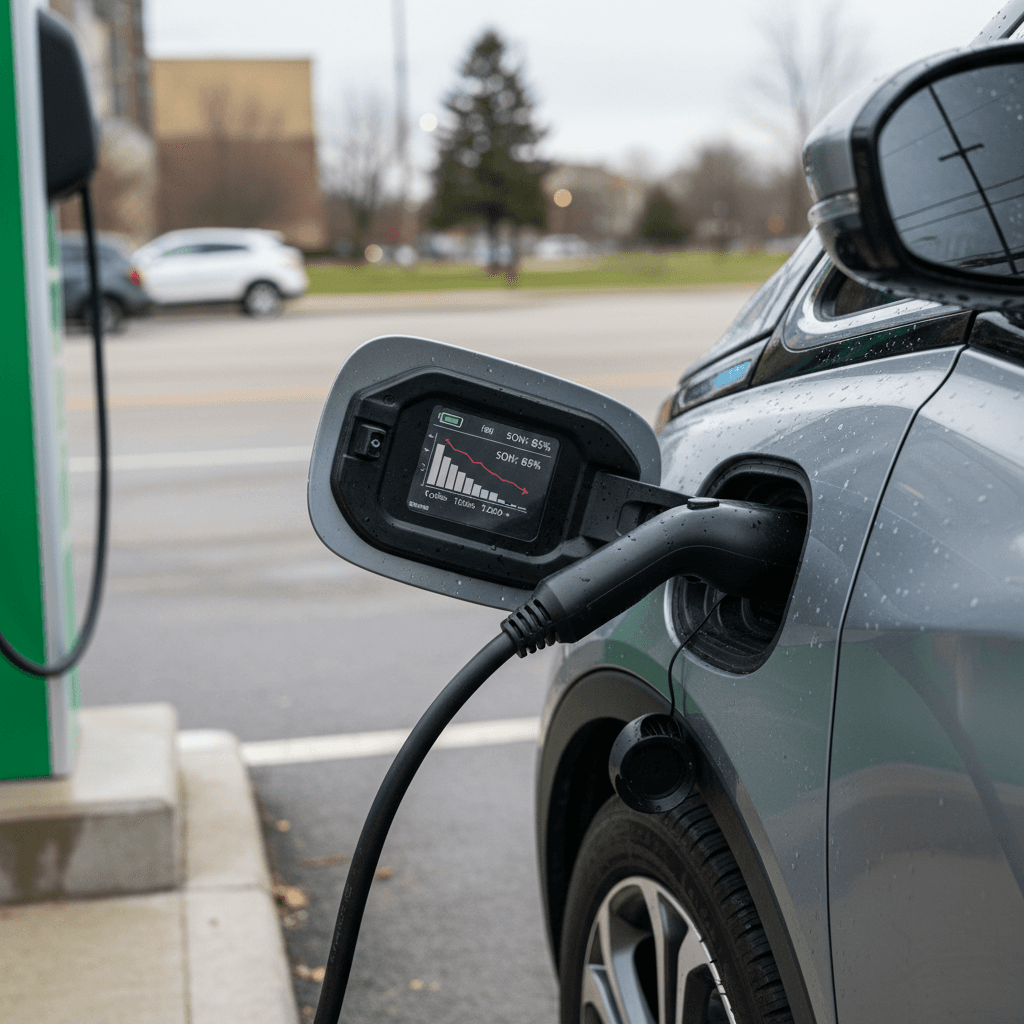
Short answer: no. The Bolt doesn’t expose SOH to the driver in any built‑in screen or menu. You get a bar‑style SOC gauge, an estimated range, and some charging graphics, but nothing labeled state of health.
- On the instrument cluster: a vertical stack of green bars for charge level; each bar represents about 5% SOC.
- On the energy and charging screens: graphics that show your charge target in 5% increments, plus estimated time to full when charging.
- In the myChevrolet app: if you have an active connected‑services plan, you can typically see SOC in 1% increments and charge status. Some owners report losing this detail without a paid OnStar or data plan.
Where to see an actual percentage
Practical ways to estimate Chevrolet Bolt EV state of health
Just because the Bolt doesn’t show SOH directly doesn’t mean you’re flying blind. Owners and technicians use a few practical methods to estimate the Chevrolet Bolt EV’s state of health.
Four ways to gauge your Bolt’s battery health
From “quick and dirty” to technical
1. Range at full charge vs EPA
Charge the car to 100% on a mild day (around 65–75°F), then:
- Reset a trip and drive normally from near‑full to near‑empty on mixed roads.
- Track miles driven and energy used in kWh on the Driver Information Center.
- Compare real miles to the original EPA range (roughly 238–259 miles depending on model year, battery, and EUV vs EV).
If you’re consistently close to EPA range on similar routes, your SOH is likely still high.
2. kWh used on a deep discharge
For a more technical pass:
- Start near 100% SOC.
- Drive down to low SOC (single‑digit % or until “Propulsion power reduced” message).
- Note the kWh used on the trip display.
Add a few kWh for the remaining buffer and compare total to the pack’s original usable capacity (around low‑60s kWh for most recall packs). The ratio gives an approximate SOH.
3. OBD‑II + scan app
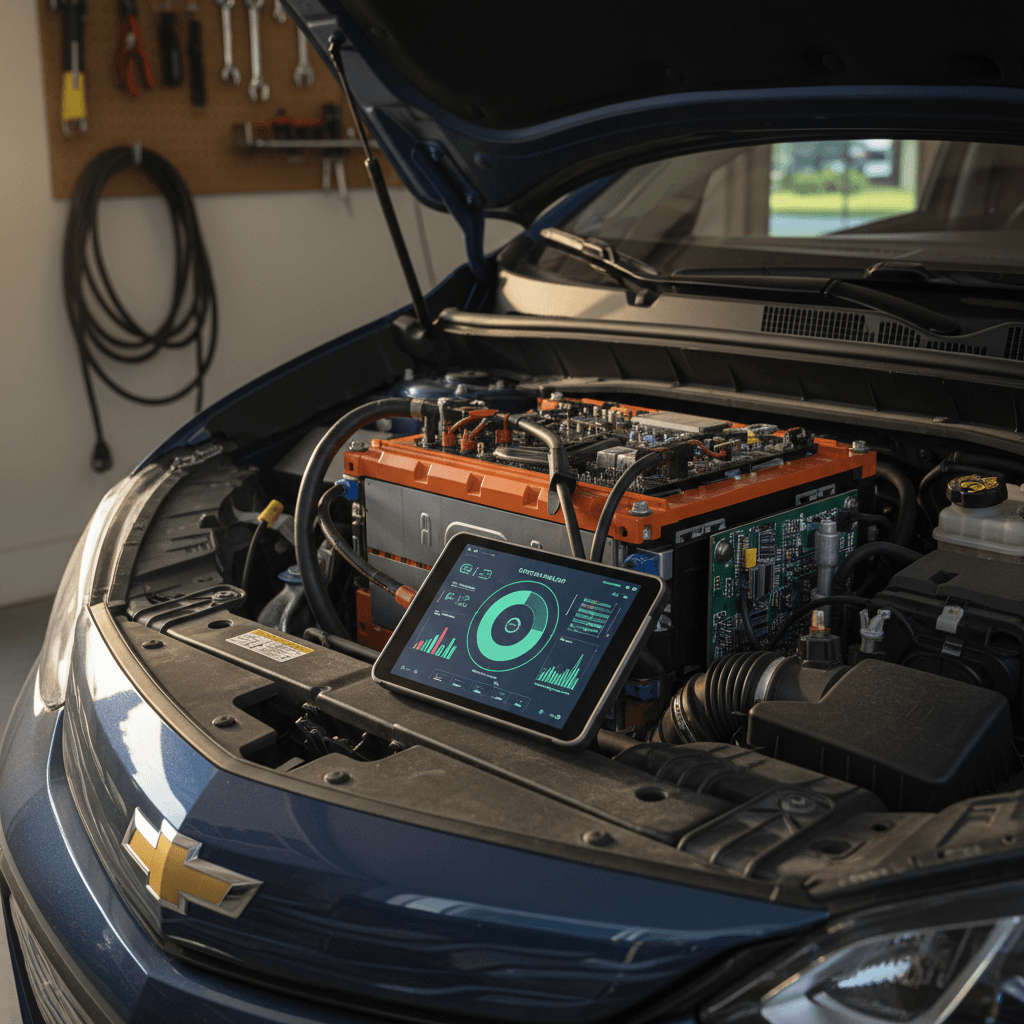
With an inexpensive Bluetooth OBD‑II dongle and an app like Car Scanner or OBD Fusion, some owners read the Battery Management System’s internal capacity estimate.
This can give a direct kWh number, but remember: it’s still an estimate and can jump around after software updates or unusual driving.
4. Professional diagnostic test
A shop with EV experience, or a marketplace like Recharged, can run structured charge/discharge tests or use proprietary tools to measure energy throughput.
At Recharged, those results roll into the Recharged Score Report, so you see verified battery health without doing the math yourself.
Make your own “baseline run”
Real‑world Chevy Bolt EV degradation: what owners report
Every Bolt is used differently, but owner data paints a fairly consistent picture for the Chevrolet Bolt EV’s state of health over time, especially for cars with the newer recall packs.
Typical Chevy Bolt EV battery behavior in the real world
Forum threads and owner logs regularly show examples like:
- 2022 Bolt EUV with about 20 months and ~16,000 miles: back‑of‑napkin math suggesting ~7% degradation, with owners pointing out how temperature, rounding, and driving style can skew a single estimate.
- 2017–2019 Bolts with recall replacement packs: OBD‑based readings in the low‑60s kWh shortly after installation, drifting down a few kWh over tens of thousands of miles.
- High‑mileage Bolts (well over 100,000 miles) whose drivers are still beating or matching EPA range on efficient routes, despite modest measured capacity loss.
The good news
Bolt EV recall, replacement packs, and what they mean for SOH
You can’t talk about Chevrolet Bolt EV state of health without talking about the battery recall. GM recalled large numbers of 2017–2022 Bolt EV and EUV packs because of a manufacturing defect that could, in rare cases, lead to fire. Many cars received brand‑new battery packs, effectively resetting their SOH clock.
What a recall replacement pack means
- Newer chemistry and manufacturing compared with early packs.
- Effectively a “younger” battery, even if the car is several years old.
- Many owners see usable capacity in the low‑60s kWh range, which lines up with a healthy pack.
What you still need to check
- Was the recall performed, and when?
- Is the latest diagnostic software installed?
- Has the car had any subsequent recall campaigns related to charging or fire risk addressed?
Why software matters too
For used‑car shoppers, a Bolt with a documented replacement pack and up‑to‑date software can actually be more attractive than an early car that never needed recall work, because you’re effectively getting a newer battery.
What is a “normal” Chevrolet Bolt EV state of health by age?
Because GM doesn’t publish SOH targets by year, we’re in the world of expectations, not guarantees. But based on owner data, EV battery behavior, and the Bolt’s pack specs, you can use the following as a rough sanity check, not as a lab‑grade rule book.
Ballpark expectations for Chevy Bolt EV state of health
Approximate SOH ranges for a well‑cared‑for Bolt EV or EUV, assuming moderate climate and typical usage.
| Pack age (since installation) | Typical mileage range | Healthy SOH band (approx.) | What you’ll notice as a driver |
|---|---|---|---|
| 0–2 years | 0–25,000 miles | 95–100% | Range is at or near original EPA numbers in mild weather. |
| 2–4 years | 15,000–50,000 miles | 90–96% | You may see a small drop on long trips, but daily driving feels unchanged. |
| 4–6 years | 35,000–80,000 miles | 86–93% | Highway road trips require slightly more planning; city driving is still easy. |
| 6–8+ years | 60,000–120,000+ miles | 80–90% | Range drop becomes noticeable, but the car remains perfectly usable for many commutes. |
These are estimates based on real‑world behavior; individual cars can sit outside this band for many reasons.
Climate and use can move you off the curve
Habits that protect your Bolt EV battery health
You can’t stop chemistry, but you can nudge it in your favor. The same habits that help any EV pack age gracefully apply to the Chevrolet Bolt EV’s state of health as well.
Everyday habits to keep your Bolt EV’s SOH high
1. Use charge limits for daily driving
For most commutes, set the Bolt’s charge target around <strong>70–80%</strong> instead of 100%. Save full charges for road trips or when you truly need the range.
2. Avoid sitting full or empty
Try not to leave the car parked for days at 100% or nearly at 0%. If you’re storing the car, aim for roughly 40–60% SOC and keep it in that band.
3. Be kind with fast charging
DC fast charging is great on road trips, but regular use at high SOC and in hot weather can stress the pack. When possible, fast‑charge from ~10–20% up to ~70–80%, not all the way to full.
4. Watch temperature extremes
The Bolt manages its pack temperature, but you can still help it. In heat waves, avoid repeated fast‑charge sessions back‑to‑back if you don’t need them. In bitter cold, expect reduced range but not permanent damage.
5. Keep software up to date
Recall fixes and battery management updates aren’t just about safety; they also help the car estimate and manage battery health more accurately.
6. Drive smoothly when you can
Hard launches and repeated heavy regen won’t instantly kill a pack, but smoother driving spreads load more evenly across the cells and reduces thermal stress over time.
Used Chevy Bolt EV buying checklist: battery‑focused
When you’re looking at a used Bolt EV or EUV, you rarely get a neat SOH number from the seller. Instead, you’re reading the tea leaves: paperwork, behavior on a test drive, and any diagnostic data you can get your hands on.
Battery‑focused checklist for a used Chevrolet Bolt EV
1. Confirm recall and software status
Ask for documentation showing the battery recall work (if applicable) and any later software or diagnostic campaigns. You can also run the VIN through a Chevy dealer to confirm open recalls.
2. Note the build year vs pack age
A 2018 Bolt might have had its pack replaced in 2022. That’s a much younger battery than the model year suggests. Pack‑replacement paperwork is a big plus.
3. Check remaining battery warranty
Most Bolts carry an <strong>8‑year/100,000‑mile</strong> high‑voltage battery warranty (from in‑service date). Ask the seller for an in‑service date or estimate remaining coverage with the VIN.
4. Do a thoughtful test drive
Start with a reasonably full charge and drive 20–40 miles on mixed roads. Note the efficiency (mi/kWh), range drop, and whether the car behaves normally near low SOC.
5. Look for warning lights or odd behavior
Any battery, propulsion, or charging warnings deserve attention. Don’t assume they’re minor, have them scanned or negotiate accordingly.
6. Ask for a battery health report
If you’re buying through a marketplace like <strong>Recharged</strong>, you should see a <strong>Recharged Score Report</strong> that documents battery health, range testing, and any relevant recall work.
How Recharged evaluates Chevrolet Bolt EV battery health
Because the Chevrolet Bolt EV doesn’t show state of health on the dash, Recharged treats battery evaluation as a first‑class job, not an afterthought. Every Bolt we list goes through a structured process so buyers aren’t guessing.
Inside a Recharged battery assessment for a Bolt EV
1. VIN & recall research
We start with the car’s VIN to pull factory equipment, in‑service date, and any open or completed recalls, including pack replacements and diagnostic software campaigns.
2. Diagnostic scanning & tests
EV‑trained technicians scan for trouble codes, confirm software versions, and when appropriate, read battery data via OBD tools. We pair that with real‑world driving or charge/discharge tests to see how the pack behaves.
3. Recharged Score Report
All of that gets distilled into an easy‑to‑read Recharged Score Report that summarizes battery health, estimated range, and how this specific Bolt compares with similar cars. You don’t need to be an engineer to understand it.
Why this matters if you’re financing or trading in
Chevrolet Bolt EV state of health: FAQ
Common questions about Chevy Bolt EV battery health
Bottom line: how to think about Bolt EV battery health
The Chevrolet Bolt EV’s state of health isn’t a neatly labeled number on the dash, but it’s not a mystery, either. With a little structure, you can use real‑world range, kWh usage, paperwork, and (when needed) diagnostic tools to build a clear picture of how healthy a given pack really is. Most Bolts that have had their recall work handled and are driven reasonably show slow, predictable degradation, and a replacement pack can make an older car surprisingly fresh.
If you’re shopping used, focus on pack age, recall history, warranty status, and how the car behaves on the road, and don’t hesitate to lean on expert help. Recharged was built to take the guesswork out of used EVs, with verified battery health in every Recharged Score Report, financing and trade‑in options, and EV‑specialist support from first click to delivery. That way, when you fall for a Chevy Bolt, you’ll know its battery is ready to go the distance with you.